The Symbiotic Aquaponic Cycle
AQUAFLY links biological and technical processes into a circular production system. Their interactions determine resource efficiency and ultimately the economic and environmental performance of the system.
The symbiotic aquaponic cycle
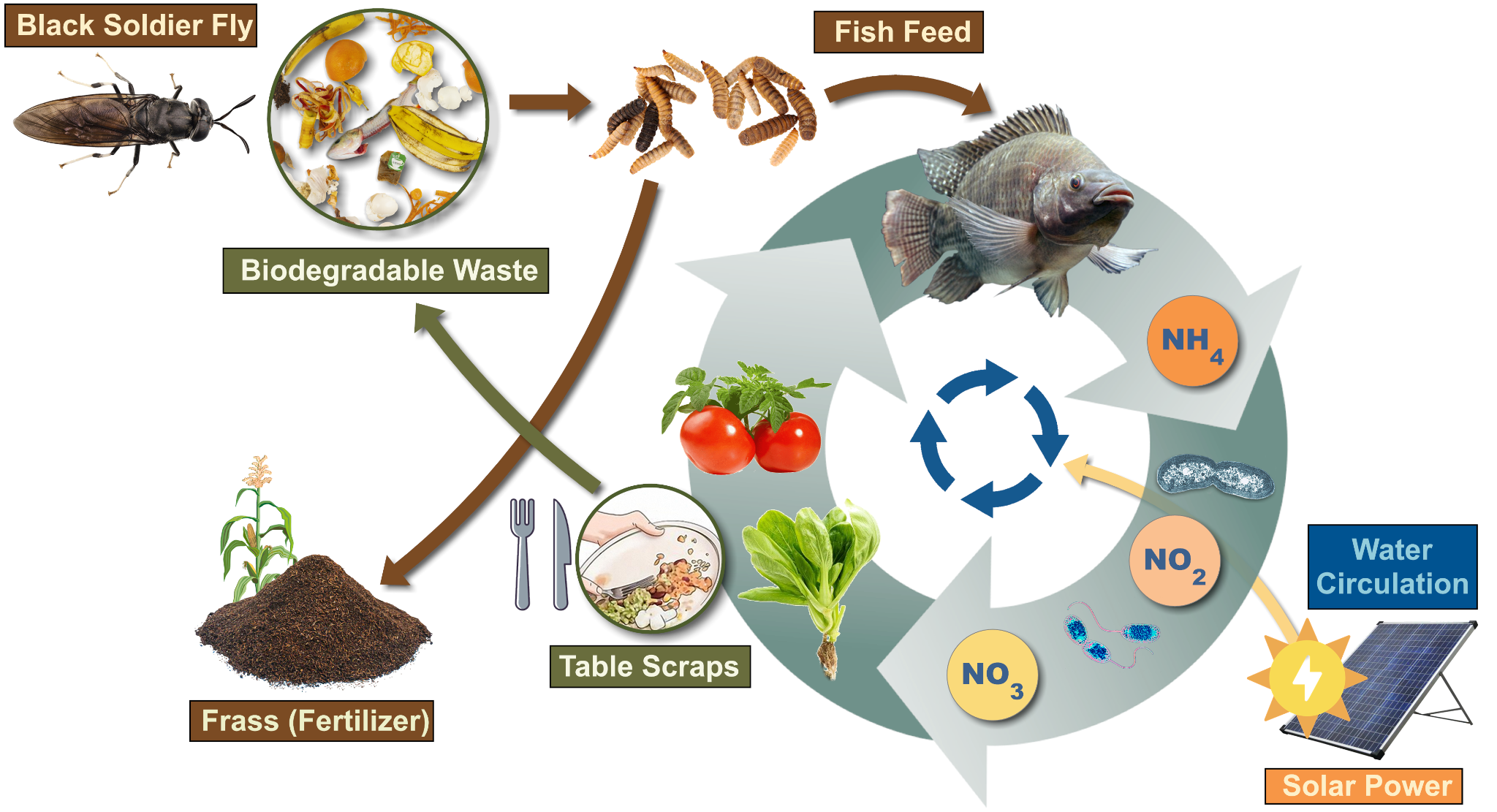
Aquaponics combines aquaculture, hydroponics and beneficial bacteria. Within this synergism, the negative environmental impacts of aquaculture and hydroponics become advantages in a symbiotic environment. The illustration depicts the material flow and connections between components in the pilot aquaponic production system with integrated BSF rearing.
This closed-loop system involves the conversion of fish waste into nutrients based on bacterial activities for plant growth. Ammonium (NH₄⁺) from fish waste is initially converted to nitrite (NO₂⁻) by Nitrosomonas, followed by Nitrobacter, which converts it to nitrate (NO₃⁻). The nitrate is subsequently absorbed by plants for growth, and the purified water is returned to the fish tank.
Organic waste remaining on the farm can be utilised to cultivate Black Soldier Fly larvae. Depending on demand for fish feed, external organic waste may be required, which could also contribute to addressing waste-management challenges in developing countries. The larvae are used as a high-quality protein component in fish feed produced on-site. Frass, the residual material from insect rearing, is a valuable organic fertilizer for agriculture.
Such a system design corresponds to the concept of a circular bioeconomy, in which waste from one process becomes the resource of another. The power required for water-circulation pumps can be supplied by small solar-power systems, with batteries providing back-up during night-time hours.